Archived · Jazz and Beyond · Jazz · 5 min read
Peter Wockner's Q&A with contemporary music ensemble Misinterprotato 29 September 2008
Peter Wockner's Q&A with contemporary music ensemble Misinterprotato 29 September 2008 Misinterprotato are one of Australia's most inventive…
This date is the archive capture date; the original publication date was unavailable.
Historical article recovered from a Wayback capture dated 2018-02-24.
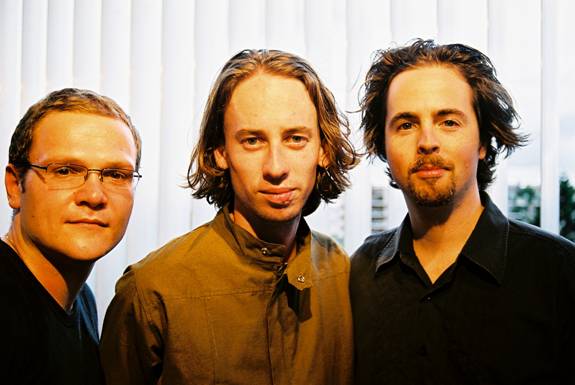
Misinterprotato are one of Australia’s most inventive contemporary music ensembles.
Much loved by the intensely creative Brisbane music scene they are so much more than a traditional jazz trio. The group expands the capacities of the classic piano/bass/drums combination with elements of the avant-garde and a fresh attitude they bring to their music.
Truly captivating for a variety of audiences, Misinterprotato skillfully blend dense, exciting improvisations and delicate atmospherics, conjuring up sounds of modern jazz, ambient music, avant-garde rock, free improvisation
and contemporary classical music.
The pianist with the trio is Sean Foran. In 2007 he was the recipient of the Brisbane City Council/Arts Queensland Young and emerging Artist Fellowship which has enabled him to relocate to the UK. He is currently completing his MA at the Leeds College of Music where he is a part-time lecturer.
Peter Wockner:
Commercially, the biggest acts in Jazz over the last 20 years have predominantly been piano trios. Names like the Keith Jarrett trio, Medeski Martin & Wood, Brad Mehldau trio, EST, The Bad Plus. What do you think are the reasons for this?
Sean Foran:
hmmm, well maybe it’s just something about the combination of instruments that makes this particular trio combination really speak to people.
I think it’s also really important to remember that all the groups you mentioned there have brought something new to the piano trio format and have really set their own path and style. It’s definitely an exciting time for the piano trios, although quite challenging because lots of new sounds and ideas are coming out all the time.
PW:
Has there been a noticeable rise in the popularity of minimalism in the art form?
SF:
Not that I’ve really noticed, but I suppose there’s albums like the Pat Metheny “the way up” and Nik Bartsch’s Ronin group, both of which owe a lot to Steve Reich. Then groups like Tord Gustavsen’s trio which focus’ a lot on playing the minimal amount, only saying what needs to be said, as he puts it. It’s a really interesting area and skilled jazz musicians/improvisers seem to be able to use minimalist structures and ideas in their pieces.
We’re quite interested and influenced by minimalism and I think audiencesv really respond to it when it’s used effectively in an improvised music fashion.
PW:
How much more acoustically is there left to explore in the piano trio format and will we see even more electronic explorations in the future from Misinterprotato?
SF:
There’s always more to explore acoustically, as the way the three of us can interact and the different sounds we can create is, well not endless, but there’s enough to work with ! I’m interested in exploring more electronic ideas, but also more preparation of the instruments to achieve interesting sonic possibilities.
PW:
You’ve composed contemporary classical work and for other mediums, particularly film. How has this influenced your improvisational skills as a pianist?
SF:
As a pianist, exploring other areas of music, particularly classical is so important. For me it’s really influenced my writing and improvising mostly by allowing me to explore different harmonic ideas. Less ‘jazz based’ ones I suppose. I’ve never really learnt ‘jazz licks’ to improvise with and writing/listening to more contemporary classical music has helped me find improvising ideas that are more interesting to me.
PW:
Tell us about your background, your family history, what got you into music and how did you become influenced by improvised music?
SF:
My family aren’t really musical. I’m the only person that plays an instrument and that was because my parents made me learn when I was a kid. My dad is into jazz a bit, so I remember listening to Errol Garner records when I was a kid. That got me interested in jazz, then in my final year of high school I decided to pursue it further by studying music. I still hadn’t really heard much jazz/improvised music though, so my time at the QLD Con was quite ear-opening !
PW:
What is your main goal as an artist and how are you navigating towards that goal?
SF:
To create music that is new and music that connects with people. To achieve this I suppose I try to involve myself in projects that are stimulating, that challenge me and that create music that is interesting for the players and audience.
PW:
Do you have an active interest in any of the other arts?
SF:
I’m quite interested in architecture, photography and modern art…although I don’t have any skills in any of them really. One of the amazing benefits of living in Europe is the incredible access to the arts, I’m going to see the huge Rothko exhibition at the Tate in November. So I suppose I’m an active audience member.
PW:
In what ways does Misinterprotato use the digital age to sell its own brand or product? While it opens up many opportunities, is it now more competitive than it used to be?
SF:
We’re online with all the digital music retailers. You can purchase songs, albums and we’re looking at having scores up there too. It is really competitive and for the consumer the choice is massive. I suppose just keeping an active presence online is a good thing and you really can make it work for you. There just seems to be limitless possibilities for digital, but we haven’t really delved into it too much.
It’s more interesting to keep making music and hopefully we can get it out