Archived · Jazz and Beyond · Jazz · 8 min read
Frank Presley's interview with saxophonist and bandleader Nick Hempton 27 April 2009
Frank Presley's interview with saxophonist and bandleader Nick Hempton 27 April 2009 Nick was born into a family of classical musicians, and took up…
This date is the archive capture date; the original publication date was unavailable.
Historical article recovered from a Wayback capture dated 2018-02-24.
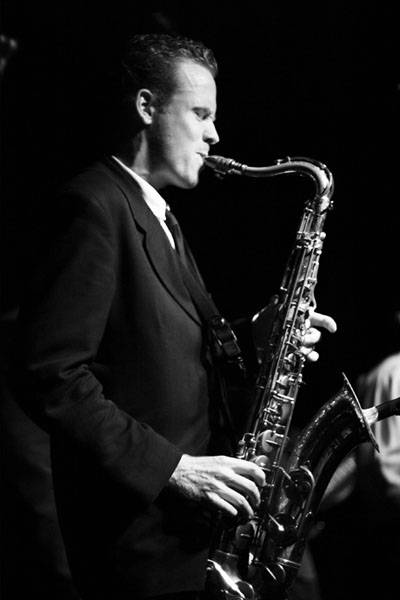
Nick was born into a family of classical musicians, and took up musical instruction at an early age. Starting with the piano at age six and the clarinet at ten, he studied and performed classical music until the age of 16 when he found himself drawn to the saxophone and jazz.
Having little jazz in his musical background, Nick forged his own way, frequenting local jazz clubs and pestering local musicians for advice and lessons. He received invaluable assistance particularly from Australian jazz greats Jason Morphett and Bobby Gebert, and by 17 was performing regularly at local jam sessions. After studying at the Sydney Conservatorium of Music, Nick embarked on his professional music career.
Based in Sydney for most of his twenties, Nick performed in a wide and varied array of musical settings from big bands to small groups to Rhythm ‘n’ Blues and Ska; most notably the Andrew Dickeson Quartet, the Brad Child Orchestra, the Dan Barnett Big Band, the Evan Lohning Big Band, John Morrison’s Swing City, James Morrison, Dale Barlow, The Bobby Gebert Quartet, Backyskank, and The Allniters.
He appeared at all the major Australian jazz festivals including The Manly Jazz Festival, The Wangaratta Jazz Festival, and The Thredbo Jazz Festival, and appeared as both performer and interviewee on Australian Radio and Television. Throughout he continued to lead and compose for his own groups.
Nick also built up an excellent reputation as a musical educator, holding private lessons and masterclasses for school- and mature-age students.
In 2004 Nick relocated to New York where he performs with and composes for his own group- The Nick Hempton Band. He performs regularly at the city’s top music venues - Smalls, the Blue Note, the Zinc Bar, Sweet Rhythm, etc.- and has appeared with a wide range of musicians including Harry Wittaker, Slide Hampton, Roy Hargrove, Dennis Irwin, James Carter, Joe Magnarelli, Barbara Morrison, Duane Eubanks, Russell Malone, Wessell Anderson, Jeremy Pelt, Eric Lewis, EJ Strickland, Claude Coleman (Ween) and many more.
Nick has appeared on many commercially released albums encompassing the full range of popular music styles and has appeared on stages throughout the world from New Zealand, The Pacific Islands, South East Asia, China, Japan, to South America, Mexico, Canada, Israel, Switzerland, England and France.
In early 2009, the Nick Hempton Band released their debut, self-titled album, and will spend the remainder of the year touring and performing and not sleeping.
Frank Presley:
Over the last decade it’s fair to say that, while maintaining its own identity, Australian contemporary jazz has found more things common with Europe than America. Like many Australians and indeed other internationals before you, you chose New York City. Why?
Nick Hempton:
I have to say that while I was playing in Australia, I was never consciously involved in performing “Australian Jazz”. I was certainly aware of it taking shape, because I think it has come into its own in the last ten or fifteen years, and I was constantly impressed with the music being made around me, but it was just not my thing. The records I was listening to, and the players I was following were from America, and specifically New York; and the idea was planted early on that this was the place to go. I should point out that energetic swinging modern jazz is of course being produced everywhere these days, and New York is not the Jazz Nirvana I was naively hoping for- it’s not the hotbed of new musical ideas it seems to have been fifty years ago. But it has the history, and the intense energy that still pushes musicians toward a distinct New York sound. It also has the largest concentration of killing drummers anywhere. I also think that for those of us who come to New York from elsewhere, there’s a desire to throw ourselves into arguably the biggest, most competitive jazz pool in the world, and see if we sink or swim. I’d like to think I’m currently dog-paddling up the shallow end…
FP:
You’ve said your music is ‘swinging mainstream/modern jazz with a UN style twist. This style is still holds a strong following in NYC. Have you found jazz as factional in New York as it seems to be in Australia or does the fact that many such as yourself migrate into the scene ‘cut through’ any perceived prejudices?
NH:
I’ll stand by the ‘swinging mainstream/modern jazz’ bit, but lines like ‘a UN style twist’ , even though I won’t deny I said it, shouldn’t be uttered outside a press-release… Now, even though I’m probably not qualified to comment on this, my impression is that the Australian jazz scene is far less factional than it was, say, ten years ago. Back then, there were certain musicians who wouldn’t talk to each other because they didn’t like the music the other was producing. I certainly hope it’s not like that now. As for New York, I’ve hardly noticed it here at all. It’s got to have something to do with the sheer number of musicians here- something that still regularly boggles my mind. You have to learn pretty quickly not to worry about what everybody else is doing, otherwise you get nothing done yourself. Maybe it has something to do with Australia’s relative isolation. Sorry to bring up that old chestnut, but in NY there’s such a tangible connection to the rest of the jazz world, with so many musicians of so many styles passing through, that the idea of forming cliques seems pointless and unnecessary. It could also be because ‘swinging mainstream/modern jazz’ is by far the prevailing music style here. Perhaps if I was a Trad or Free Jazz player, my experience would be different.
FP:
How do you balance the euphoria and the drudgery when it comes to life in New York City?
NH:
I’m glad you asked- people often tend to think life in NY must be a constant high. I have to admit that I’m still thrilled just to be here- it is an amazing place, but the struggle can be as tedious here as anywhere. I don’t know- would an answer of a steady intake of stimulants and depressants be socially irresponsible? Probably, so it’s not that. Actually, I’m not sure I’ve worked out how to balance it yet.
FP:
Have you found any fundamental differences in a typical jazz audience compared with say Sydney?
NH:
If you’d asked me this four or five years ago, I would have had a great answer. NYC has a hundred year history of jazz as entertainment. New Yorkers like to go out for a night of listening to live jazz. It’s everywhere- in bars, restaurants, train stations, street corners. They’ve grown up with it, and as a result are educated, and serious about picking quality from fakery. In Australia, aside from at a couple of specialist venues, I think Jazz is seen as an accompaniment to a good time, as opposed to a focus for attention. Australian punters might not be as picky, but they seem to enjoy themselves more.The thing is, lately the jazz club audience in NY (especially in Greenwich Village, where I spend most of my time) has gone through a noticeable change- it’s all tourists now. I don’t know where the New Yorkers are going on their nights off, but it’s not to hear jazz. It’s not necessarily a bad thing- clubs are now full of Japanese and Europeans, who love to listen- but it’s an interesting shift.
FP:
Do you think it’s harder to step out of your comfort zone musically in NYC than anywhere else?
NH:
I think it’s probably easier. Once again this comes down to the size of the jazz scene, and the constant in and outflow of musicians. I’ve been here for nearly six years, and I’m fairly sure the vast majority of players here have no idea who I am. If I want to go and try my hand at speed-metal, a) the opportunity is there, and b) it’s not like it’s going to damage any reputation I might have. Besides, stepping out of the comfort zone is one of the reasons we’re here- I’m constantly meeting and playing with musicians from different backgrounds, with different influences and preferences. It’s very rarely comfortable.
FP:
Have you detected in New York City any tangible new found hope in the jazz world since the election of Barack Obama?
NH:
I think it would take a pretty optimistic jazz musician to take hope from the election of a new politician. The US used to have a saxophone playing, pot smoking president, and now gigs, when you can get them, are still paying fifty bucks and two drinks. Does that sound jaded? I will say that there is a noticeable feeling, of relief more than hope, throughout the whole city. And America being viewed as something more than just a rather sad punchline has to be good for all of us here, musicians included. We’re all hoping for the best…
FP:
Do you plan on bringing the quartet to Australia?
NH:
I can tell you the rest of the quartet plans on me bringing them to Australia- they’ve made that quite clear. Yes, absolutely- as soon as we can afford the plane tickets, we’ll be there in a flash!