Archived · Jazz and Beyond · Jazz · 11 min read
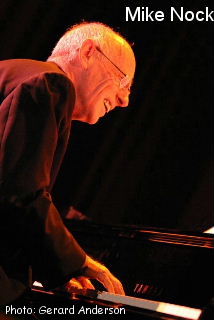
Frank Presley's interview with pianist and composer Mike Nock 25
Frank Presley's interview with pianist and composer Mike Nock 25 th July 2004 "The whole humanist tradition has been thrown out, it's all about…
This date is the archive capture date; the original publication date was unavailable.
Historical article recovered from a Wayback capture dated 2018-02-24.
th
July 2004
“The whole humanist tradition has been thrown out, it’s all about economics”
Frank Presley:
What’s the favourite part of your job, performing, composing or recording ?
Mike Nock:
I love them all actually. It would really depend on where I’m at. I mean I love them all. I really do you know.They’ve all got things that are great about them.
FP:
Does composing come easy to you ?
MN:
No it doesn’t. I’ve always composed and now I’m actually at a stage where I’m starting to decompose but that’s another story ! Seriously, it started for me back in New Zealand when I was very young and wanted to play music with some of my friends and we decided we wanted to get a band together.So anyone who was in the neighbourhood that could make any kind of a sound could be in the band and we couldn’t play anything. I could play a couple of chords on the piano. We had a trumpet player or actually a cornet player in those days that played in a brass band. A young guy you know.A kid actually ten or eleven (years of age) and he could almost play a b-flat scale I thinkSo that was his technique.We had a guitarist who could play a couple of chords and we had the odd alarm clock or whatever or anything that made a noise.But we made some music.
FP:
Were you playing ragtime in those days ?
MN:
No it was actually a form of Jazz. We were just trying to play some music. The guy could get maybe 8 notes on his cornet.We tried to figure out how to put those 8 notes together to make some music. I’m serious.Basically that’s what I continue to do to this day essentially. So that’s the essential motivation. In some ways it’s very easy. But of course as you get older, you get more critical of what you do and it takes me an inordinate amount of time sometimes to write the simplest little ditty because I’m so fussy. Usually I keep changing things until it’s just the way you want it to be.
FP:
Some people might say that your big break was when you went to Boston all those years ago and studied. But I wanted to particularly ask you about seven years later when ‘The Fourth Way’ formed.(Michael White violin, Ron McClure bass, Eddie Marshall drums). Was John Handy in that band ?
MN:
No John Handy was…what happened actually was, I was working with Dionne Warwick and with Eddie Marshall. I just really loved playing with Eddie Marshall.Eddie Marshall used to be a piano player.His dad was a piano player too.He really knew how to play for the piano because he was a piano player. So he knew how much of a drag it was to play with drummers that didn’t feel right.So when he did play the drums, and he was a very good drummer too, don’t get me wrong, but he knew what to do to make the piano player feel good. He had a real nice light thing about him that was really special to me.I got him on Dionne Warwick’s gig so we could play together, even though it wasn’t a Jazz gig, but we were playing with someone you know ?I made a record many many years ago with Bennie Maupin and Cecil McBee (Almanac) and he was in that band. So we had played together quite a bit over the years and I loved it. So then I quit Dionne for various reasons. I didn’t want to stay on because I got the money I needed to get and I wanted to just buy my piano and get back to playing Jazz full time you know ?
FP:
Back in 1967 you went to San Francisco. A very interesting time in the US both politically and socially.Did that affect the music of ‘The Fourth Way’ ? It was a music based in Jazz Rock wasn’t it ?
MN:
Well it was but I was going to say John Handy actually hired me to play in his band and he also had a violinist Michael White.Michael White and I had talked about getting a band together so when the gig with John Handy came up we decided to work on our own music and we had a falling out with John and this was when we got ‘The Fourth Way’ together.So John never actually played with the Band ‘The Fourth Way’.
You’re right, there was much political and social turmoil and it was a wonderful time.
FP:
Lets jump ahead a number of years. How difficult was the decision to return to Australia in 1985, considering Jazz was going through somewhat of a renaissance in the US at that time.
MN:
Well it was difficult but not so difficult because to me emotionally I’d much more than surpassed the goals that I’d set for myself.I said to myself if I’d make 6 records then that’s enough for me. I was always hankering after coming back to Australia, because I always remember my period in Australia.Don’t forget I cam from New Zealand.My time in Australia has been the happiest time in my life. I seem to have a lot of connections here because I used to visit quite a bit.Every time I came back I felt great and I really felt a sense of belonging here, which I never had in the US.Personal reasons actually prompted me to come back here. It wasn’t a particularly good time for Jazz when I came back.I mean Jazz has always gone through a lot of things but if I remember, that was a few years after the first oil crisis.All of a sudden it was getting pummelled on the ropes. Things weren’t happening as well. Like the record business was in trouble and had been for a few years because of the oil crisis.This was before CD’s mind you and things just became a little bit rougher. There was less work. It was a fairly grim period actually. The golden period was about five years before I came back.The Reagan years. I’ve got to say, the Reagan years were horrible.They were horrible. I mean that was the beginning of the end and it has been ever since.It’s just become contracting for free thinking spirits, for artists and humanists.The whole humanist tradition has been thrown out.It’s all about economics.
FP:
Talk us through ‘Current Reality’ briefly (Mike Nock’s Big Small Band Live ABC 981 567-6)
MN:
Basically it’s a piece that the band has been playing for a long time.It’s a pretty good feeling, high-energy Latin number. It’s always been fun for us to play.
FP:
Who are your musical heroes ?
MN:
Gee that’s a good question. Your musical heroes. There’s so many of them actually. I suppose the one for me. The man that really affected me more than anyone was Miles Davis. He’d have to be my main real musical hero and then there’s people like Sonny Rollins. He is definitely a musical hero. Then there’s younger guys like Keith Jarrett and Herbie Hancock.There’s a long list.
FP:
I’m glad you put Miles Davis up there. He’s certainly my musical hero as well.
Tell us about your most memorable gigs.
MN:
The first ones that come to mind are not the happiest experiences.I remember once I got this gig with Paul Gonsalves. He was the guy that did the Diminuendo in Blue (in the Duke Ellington concert).I always looked forward to playing with him.I was so excited about the gig.I sat down to play and the piano was something like a quarter of a tone higher.It was unplayable. There was no way anyone could get in tune with it. I was devastated. I was heart broken. I actually just drank a bottle. I got a bottle of scotch and just didn’t want to be there in any way shape or form.I was so devastated.
FP:
The name Coleman Hawkins pops up. Was that in a one off gig or were you in his touring band ?
MN:
Actually I met him first in Australia. We toured together, we didn’t play. He was in that original package that I toured with including Sarah Vaughan.He and I got along like a house on fire. I looked upon him like he was my father. Lovely guy.I was working at ‘Lenny’s on the Turnpike’ and he came in for the week. We used to have a house rhythm section and it was the who’s who of Jazz.Just about anyone you can think of during that period that went around the country by themselves played there.Benny Golson, Phil Woods, Pee Wee Russell, the whole spectrum of Jazz and ‘Hawk’ played there for one week and that was a memorable experience.
FP:
Playing with people like Sam Rivers and Tony Williams, you were almost on the fringe of the Miles Davis band in a way.Did you ever have any experiences with Miles Davis in that period.
MN:
I was always on the periphery of Miles. I used to work a lot with Teo Macero, his producer and Al Foster was playing drums in his band. I did six albums with Al and we used to play a lot together in my gigs.I know he used to talk to Miles about me. I was always so in awe of some people. Miles being one of them.I met him a few times but you just turn to …you know, you’re like an idiot. He actually called me up once but I just couldn’t…They didn’t train us for that out here you know.
FP:
You’ve been involved with music education and when I think of Jazz education in particular, I think of two different routes.Firstly the institutional education and then your ‘on the job’ experience. Gigs and so forth. Just reflecting on your time at Berklee and then gigging, what’s the preferable route for a Jazz musician to take ?
MN:
You’ve got to do both. Now a days to be a musician, to have any chance of surviving in the music business, you have to have a lot of skills. The more skills you’ve got the better chance you’ve got of surviving.That’s nothing to do with Jazz, that’s just being able to play. To be able to read, know your harmony, to be able to contribute to any kind of musical situation you might find yourself in. A Jazz musician probably has a better chance of doing that than most.That’s because you’ve got to study all the elements that go to make up contemporary music.Which is not the case if you’re a classical musician or a rock musician or something. With Jazz you’ve got to learn how to play all that stuff, but you don’t learn how to play Jazz if you’re a rock musician. From that perspective, it’s really good but there’s no way that you can really learn how to play Jazz unless you’re out there doing it, and playing with people.So both things are very important.
FP:
‘Courting the edge of angst and ecstasy’ (Mike Nock’s Big Small Band Live ABC 981 567-6) Is this a blues ?
MN:
It’s a kind of a blues. It’s definitely a bluesy feeling. I’ve actually utilised some things that sound like another song in there but maybe it is just a flavour. But it’s a bluesy type of thing definitely.
FP:
Who do you see as the most promising of our younger Jazz piano players performing in Australia ?
MN:
That’s a good question because there is some huge talent available in Australia at the moment. Several people come to mind. Two of them New ZealandersBelieve me it’s not jingoism or anything like that. Aaron Ottignon or course has made a lot of waves and boy Gerard Masters is also doing some beautiful stuff.He’s made a lot of recordings lately and gee I’ve been really impressed with the stuff I’ve been hearing on records.That’s the beauty of this music.It’s about who you are. They are quite different players.
FP:
Let’s talk about Jazz audiences now. What have you noticed about the differences of say American, European and Australian Jazz audiences ?
MN:
Well that’s a good question actually. I feel generally that Australian Jazz audiences have actually come a long way.I think they are much more sophisticated now then I ever remember. The kind of audiences that come along to my gigs, usually have listened to a lot of music. You can hear music if you’re interest in music. It’s easy to get access now days. You hear CD’s, the internet if you want to. Maybe in Europe they are more generally used to be supporters of the arts.In Australia, the audiences do have, I always feel, a little bit of a thing like ‘show me’.You have to work. In other words they are not necessarily predisposed to like what you do here.