Archived · Jazz and Beyond · Jazz · 13 min read
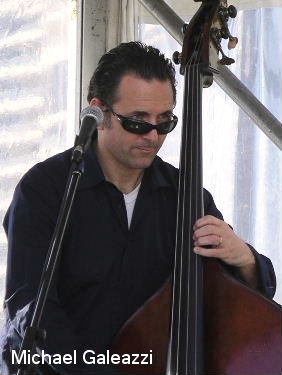
Frank Presley's interview with bassist Michael Galeazzi of the Java Quartet 24
Frank Presley's interview with bassist Michael Galeazzi of the Java Quartet 24 th July 2005 "If you've got an audience that's with you and watching and…
This date is the archive capture date; the original publication date was unavailable.
Historical article recovered from a Wayback capture dated 2018-02-24.
th
July 2005
“If you’ve got an audience that’s with you and watching and giving you energy, the music can go everywhere and it gets exciting.”
Frank Presley:
Back in 1994, what was your vision for the ‘Java Quartet’ and did you ever believe you’d be releasing its fifth album?
Michael Galeazzi:
I just had a bunch of tunes kickin’ around and I did a musical called ‘Bad Boy Johnny and the Prophets of Doom’ back in 1993 at the Enmore Theatre and it had Christine Anu and Doc Neilson and Chris Bailey from the Saints. It was a failed rock musical failed. But I had a wad of cash in my pocket. I was teaching at St Ignatius Riverview College and they kindly agreed to let me have a room with a piano and I got my players and Keith and we went in and just spent an afternoon recording and that spawned the EP and it was just good enough to release.
FP:
That was ‘Slumber for Nordic Wonder’. Who are your musical heroes and what are the most important things you’ve learnt from them?
MG:
That’s a big question. In relation to the Java Quartet, I was always enamoured of the Wayne Shorters the Coltranes and Miles Davis. That sort of cool modal jazz. I’ve always thought that was the grooviest expression of those times. Be Bop I really love and appreciate and wish I could play it. It’s a social revolution and the guys that are really good, it’s a vocation. I came in through the pop and RnB. I was playing a lot of electric bass more like Sly and the Family Stone and James Brown and all that sort of stuff. I was a little indie rocker in my teens and then I got stuck into the funk thing. Someone gave me ‘Kind of Blue’ and that was it for me.
FP:
Isn’t it amazing that album is a common denominator for so many people?
MG:
Miles Davis saved the music by pushing it forward. The whole sociological history of American music and the way it’s evolved. I suppose people were getting more insular and trying to protect their art form. Be-Bop was more like a social revolution. Like hey whities play this and play twice as fast and change it and make all the money off this you so’s and so’s. Miles and those cats brought more of an artistic beautiful thing back into the music. Music for people, cool jazz, chill it out, just as challenging, just as hard to make sense but trying to bring the listener back in. That’s where I kind of like the hipnos of music. Indian music and ragas. Shorter and Coltrane were even bringing those kind of things and that’s bringing jazz into the greater scope of improvisational music as it relates to civilisation. Those sort of things, the Gregorian chants, twirling dervishes, Eastern mysticism and you know a lot of art, bloody art, it’s all art. Music is coming back to community. The major record companies have blown it. Everyone’s downloading. It’s a political statement against those guys ripping off artists and the public for so many decades.
FP:
Artists are now releasing music under their own record labels. Tell us a little bit about the tune ‘In the Swim’ (the first track from the album ‘Deep Blue Sea’)
MG:
In the swim, life, evolution, sperm swimming. Life goes on and the tadpole analogy. This is kind of like the family album. Birth conception.
FP:
The Java Quartet has developed a unique sound. You’ve had a few people through the saxophone chair in the Java Quartet. How did you go about choosing Matthew Ottignon to continue that sound? To me, he fits in so well.
MG:
I just asked him. I was talking with Mike and Greg and he was our only choice. It’s been circumstance. Richard’s gone off and joined the Air Force big band. I really wanted to go back to the more boisterous days of the Jason Cooney era. Matt’s got everything and he’s just him and he does his own thing. It was really organic. Well it was you know, it’s a cliche. Before this album, we just did 3 or 4 gigs couple of rehearsals and let’s go. Luckily for us it just kind of worked and was good fun all round.
FP:
The new recording ‘Deep Blue Sea’. Tell us about the different approach to the recording in Byron Bay?
MG:
A romantic notion of relocating to record an album. I’ve done it tons of times with ‘Karma County’ where if you get out of town, all you do is focus on the music. It’s fun you know. You get in the car with the gang. We’re off. We’re going to spend some special time just to put some stuff down. We had 3 days in the studio. When we were in there. It was the old Festival Heritage studios and it was only just operating a couple of months when we got in there. Lucky enough to have Paul Pilsneniks up there. He’s the in house guy who I was already familiar with. We took Keith Walker (producer/engineer) up with us as well. We were just nutting out the space. We got in there in the morning and we were trying a few different set ups in this L shaped room and only had one useful isolated room with windows for site lines. Talking about configurations and Keith came up with the idea let’s all just get in a circle, mike it up and go. There was about 20 minutes we were going ‘do we really want to do this?’ Because postproduction it leaves fewer options. Ironically on ‘Dark Garden’ in Sony studios in Hargrave street. Great rooms, great isolation, site lines and windows and we’d had the drums in the big room with the piano, saxophone and bass in the little room and we ended up opening up all the doors and windows anyway to get spillage so it actually sounds live and we like to record air or just the space within the room. All you are doing is documenting a portion of time and anything that goes on within the room. Vibe or what Quincy Jones says ‘You’ve got to leave enough room for the Lord to walk through’. All the great albums from both jazz and pop just had people in a room playing. Keith was the bright spark that fateful day. Headphones even got in the way. I give him that much freedom because I think he’s part of the band. I suppose that was our greatest experimentation really to date. Abandoned ye old separation.
FP:
It’s a fine album. I think it’s the best of the five albums to date.
MG:
You hope so. It’s got a nice little warmth to it.
FP:
Tell us about ‘The Leaving Song’.
MG:
I nutted that one out in about 10 minutes before I got in the van to go on another ‘Karma County’ tour. My wife is beautiful. She’s had no issues with any of my career choices, paths or any pressure whatsoever. I was just going again. She just felt sad. Get in the van. This song just ended up being the expression of that. Nothing tragic or anything. Just one of those moments.
FP:
How do you approach composing music?
MG:
Who knows? I’ve got to sit around and wait for it. I can never work at it.
FP:
It doesn’t come easy
MG:
It does when it comes. When it comes it’s damn easy and I don’t think about. I’m not a tortured composer by any means.
FP:
How long did it take to come up with the music off ‘Deep Blue Sea’?
MG:
Couple of months of bits of paper. You’ve got an idea. A lot of times when I am practising I get an idea or a notion and you run to the piano and just work on it. For this it would have been about 4 or 5 months.
FP:
What sort of music do you enjoy listening to yourself?
MG:
At the moment I’m going through a contemporary phase. The Gorillas. Cog a Sydney based hard rockin trio. Kickin at the moment. Cold Play’s latest. Trying to keep contemporary. Trying to listen to what’s happening now. I find that for me that’s important.
FP:
Does that have a direct influence over the music of the Java Quartet? Do you finding yourself hearing it in the music you produce.
MG:
It would have to really. It’s got to go through the old sausage factory. We’re only a product of an environment. I hope so. The old modal tradition is kind of retro. So I am trying to be half retro and half contemporary with forms and ideas. I suppose ‘In the Swim’ is a groovier kind of drum and bass sort of thing.
FP:
It’s very accessible modern jazz. It’s a straight ahead jazz album but it’s very accessible
MG:
Look I’m a simple fella. That’s what I like. I want people to come closer not further away.
FP:
Tell us about ‘Seek Ye the Kingdom’ (for Mabel Hawkins)
MG:
My Grandma. That’s the title of one of her paintings. She was an abstract expressionist. She studied with Citrus Auburn. Quite a famous painter around the 30’s and 40’s. She was some crazy gal. I’ve got a whole bunch about 20 canvases at home. You can follow her work straight down the line. Beautiful still life’s, shade and light, very beautiful. It just keeps on getting more and more blob like. Very hard palette knife. Lots of relief. This painting would have been about a metre and half tall and half metre wide. Like a panel and it was all ochres and different sort of browns.
FP:
You were using borrowed instruments at Bennett’s Lane?
MG:
Michael Tortoni down there is very proactive and he’s trying to make it easier for musicians to be able to tour and come to his club. He let me use his beautiful French bass about 150 years old.
FP:
Putting your double bass on a plane must cost a lot of money?
MG:
It’s all right. I’ve got it at about 32.4kg . You ask Lloyd Swanton about this. As long as you haven’t got too many items. We’ve only been doing 1 or 2 nighters so our personal luggage is mostly taken on board luggage. The Bennett’s Lane gig was lovely. Fantastic venue 7 nights a week jazz. We don’t have anything like that in Sydney. Not dedicated 7 nights a week. He’s got two rooms now and he often has two rooms running on the same night as well. We were fortunate enough that both Kenny Weir and Adrian Jackson both popped their heads in for about 1 set. It was lovely that Kenny commented to me that even with all the borrowed gear that we still sounded like ‘Java’. I suppose with a project like this you want personalities and people. We are the sum of the parts. Because we have been playing together for so many years, you sort of develop your own sonic space, where no one treads on your toes. By definition we just jump on stage, tune up your instruments and start playing. The dust settles to the bottom of the glass and here is our mix. Because it’s not a huge venue you haven’t go the PA influencing the sound too much. Live sound off stage a little bit of piano and saxophone in the PA to get it around the room.
FP:
You’ve worked in different parts of the world. How are Australian audiences different from other audiences in relation to jazz and modern jazz especially?
MG:
It’s funny, in a commercial sense; jazz in Australia is very much the noise in the background while you have your wine and your conversation. There are maybe a few dedicated venues where you are inclined that you should be listening and quiet. But of course if people pay their money to come through the door, they just want to have dinner and a few wines and a good time and ah look there is some music going on as well. I don’t have too much of a problem with that. People pay their money and they want music to be part of their whole experience. You’ve got to be thankful for that or there won’t be any music at all. Music is a part of life. Hopefully it plays its role and its function will always be there. But sometimes it’s really hard to play more delicate music. Even in dedicated music venues you still really don’t get that concert like atmosphere. It always leans toward the pub rock end of things where it’s the soundtrack to getting pissed and having a fight, or trying to pick up someone of the opposite or same sex. Jazz seems to fall under that banner. You don’t have that artistic differentiation where maybe in Europe you do. They’ve got a couple more centuries worth of culture. We’re only 200 years old out here and they are thousands of years old. Any society with a greatly developed culture has a huge artistic history because that’s how you really measure society through the ages through their art. They are a lot more opinionated overseas. They will sit there and it’s almost a little bit disturbing. They will check you out. They’ve come to a performance and they have come to make a valued judgement on the performance that’s put in front of them. It’s great they’ll either hate you or they’ll like you. But they’ll always appreciate the effort. The one example that comes to mind especially with Java, when we did Montreux, we also did a gig at the Australian embassy in Bonn at the Boomerang Bar. Underneath the embassy they actually put a corrugated tin roof shed. It was the 4th July and all the Americans had come over. There was a whole bunch of people just sitting there watching and there was a whole bunch of people getting drunk at the bar. A good excuse to drink beer. I will never forget at the end of the performance, this German woman made a point of coming up to me and said ‘you know we Germans we were all up the front and we were sitting and watching. It was the Americans and the Australians who were making all that noise’ She wanted me to know that they were there and they were listening and they really enjoyed it and she was almost apologetic for all the other people making the noise through the performance. That’s stuck with me until today. The listener over there is part of the experience. It’s so true with music like this. The gig is elevated by the audience. If you’re playing to indifference, the music can only go to a certain level and you keep on trying but it will not go beyond that level. If you’ve got an audience that’s with you and watching and giving you energy, the music can go everywhere and it gets exciting. Unfortunately with this sort of music it is a two way street.